


Marlous van der Waal
Gepubliceerd op 18 maart 2026
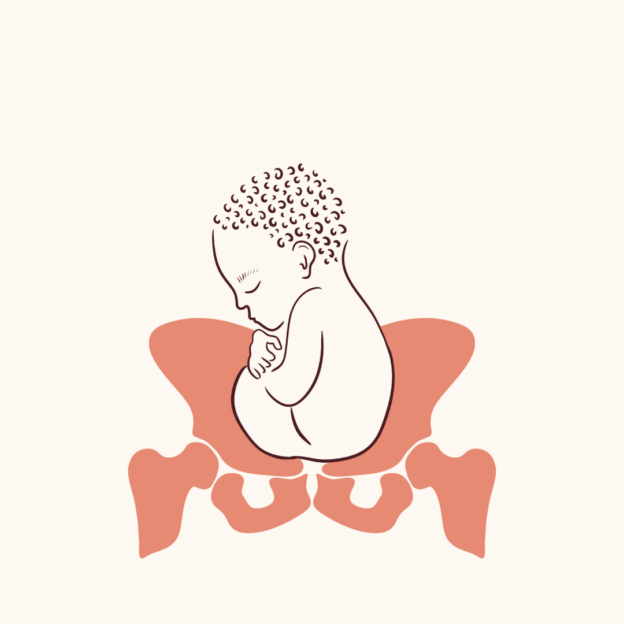
Een baby in stuitligging is een variatie van ligging, net zoals bijvoorbeeld hoofdligging of dwarsligging tijdens de zwangerschap. Tegelijkertijd wordt een stuitligging in de huidige geboortezorg geassocieerd met een grotere kans op complicaties tijdens de baring dan een hoofdligging. Na de publicatie van de Term Breech Trial in 2000 is het aantal geplande keizersneden bij een stuitligging wereldwijd sterk toegenomen. Een keizersnede heeft echter ook nadelen en risico’s voor de moeder en kan gevolgen hebben voor eventuele volgende zwangerschappen. Lees meer hierover in ons artikel Sectio (keizersnede) en VBAC & CBAC en Niches & Caesarean Scar Disorder.
Tijdens de zwangerschap wordt daarom vaak gekeken of een baby die in stuitligging ligt, nog naar een hoofdligging kan draaien. Eén van de mogelijkheden hiervoor is een uitwendige versie, waarbij de baby via de buik van de moeder wordt gedraaid.
In dit artikel staat de stuitligging tijdens de zwangerschap centraal: wat een stuitligging is, hoe vaak deze voorkomt en welke mogelijkheden er zijn om de baby naar hoofdligging te laten draaien. De manier van bevallen bij een stuitligging, bijvoorbeeld een vaginale stuitbevalling of een keizersnede, komt in een apart artikel en in de masterclass over stuitligging aan bod, die in hoofdstuk 7 staat.
- Adjaoud, S., et al. (2017). Is trial of labor harmful in breech delivery? A cohort comparison for breech and vertex presentations. J Gynecol Obstet Hum Reprod. https://pubmed.ncbi.nlm.nih.gov/28412313/
- Van den Berg et al (2008). Effectiveness of acupuncture-type interventions versus expectant management to correct breech presentation: a systematic review. Complement Ther Med. https://doi.org/10.1016/j.ctim.2008.01.001
- Borbolla Foster et al. (2014). Lessons to be learnt in managing the breech presentation at term: An 11‐year single‐centre retrospective study. Australian and new zealand journal of obstetrics and gynaecology
- Coyle et al. (2023). Moxibustion for turning a baby in breech position. Cochrane. https://doi.org/10.1002/14651858.CD003928.pub4
- Curet (1982). Management of footling breech presentation. Effectiveness of acupuncture-type interventions versus expectant management to correct breech presentation: A systematic review. (z.d.). https://www.sciencedirect.com/
- Fernandez et al. (1997). A randomized placebo-controlled evaluation of terbutaline for external cephalic version. Obstetrics & Gynecology, 90(5), 775–779.
- Goffinet, F., et al. (2006). Is planned vaginal delivery for breech presentation at term still an option? Results of an observational prospective survey in France and Belgium (PREMODA study). American Journal of Obstetrics and Gynecology, 194(4), 1002–1011. https://pubmed.ncbi.nlm.nih.gov/16580289/
- Håheim, L. L., et al. (2004). Breech birth at term: Vaginal delivery or elective cesarean section? Acta Obstetricia et Gynecologica Scandinavica, 83(2), 126–130. https://pubmed.ncbi.nlm.nih.gov/14756727/
- Hannah, M. E., et al. (2000). Planned caesarean section versus planned vaginal birth for breech presentation at term: A randomised multicentre trial. The Lancet, 356(9239), 1375–1383. https://pubmed.ncbi.nlm.nih.gov/11052579/
- Impey, L. W. M., Murphy, D. J., Griffiths, M., & Penna, L. K., on behalf of the Royal College of Obstetricians and Gynaecologists. (2017). Management of breech presentation (Green-top Guideline No. 20b). BJOG: An International Journal of Obstetrics & Gynaecology. https://www.rcog.org.uk/guidance/browse-all-guidance/green-top-guidelines/management-of-breech-presentation-green-top-guideline-no-20b/
- Kouam, L., et al. (1980). Cord prolapse in breech presentation. https://pubmed.ncbi.nlm.nih.gov/7445828/
- KNOV. (2006). Standpunt uitwendige versie. Koninklijke Nederlandse Organisatie van Verloskundigen.
- Moxibustion for turning a baby in breech position. (2021). Cochrane Database of Systematic Reviews. https://www.cochranelibrary.com/
- Nassar et al. (2006). Diagnostic accuracy of clinical examination for detection of non-cephalic presentation in late pregnancy: Cross sectional analytic study. BMJ, 333, 578
- NVOG. (2008). Richtlijn stuitligging. Nederlandse Vereniging voor Obstetrie en Gynaecologie.
- Peitsidis et al. (2021). Delivering into the Mounting Evidence of a Probable Link between Maternal Hypothyroidism and Breech Presentation at Term: What Do We Know until Now?J Clin Med. 2021 Mar 8;10(5):1120.
- Rietberg, C. C., et al. (2005). Term breech deliveries in The Netherlands: A comparison between planned vaginal and planned caesarean delivery. BJOG: An International Journal of Obstetrics & Gynaecology. https://pubmed.ncbi.nlm.nih.gov/15663585/
- Rijnders, M., et al. (2008). A retrospective study of the success, safety and effectiveness of external cephalic version without tocolysis in a specialised midwifery centre in the Netherlands. Midwifery, 24(1), 38–45. https://doi.org/10.1016/j.midw.2006.11.001
- Vlemmix, F., et al. (2014). Planned cesarean section versus planned vaginal delivery in term breech presentation: Perinatal outcomes. Acta Obstet Gynecol Scand. https://pubmed.ncbi.nlm.nih.gov/25113411/
- Wärsame, M., et al. (2023). Outcomes of a second external cephalic version for management of malpresentation. American Journal of Obstetrics & Gynecology, 228(1, Suppl.).
- Wastlund et al. (2019). Screening for breech presentation using universal late-pregnancy ultrasonography: A prospective cohort study and cost effectiveness analysis. PLOS Medicine, 16(4), e1002778.
- Wickham, S. (2014). What was the Canadian Term Breech Trial? https://www.sarawickham.com/
- Wickham, S. (2019). A few reasons to be cautious about the idea of routinely scanning for breech presentation near term https://www.sarawickham.com/
>
> Bevat
- 9 Hoofdstukken
- 4 Paragrafen